Writer, artist, filmmaker, columnist for Outside Magazine. My newsletter about creativity, adventure, and enthusiasm goes out to 15,000+ subscribers every week.
Is It Just Music?
|
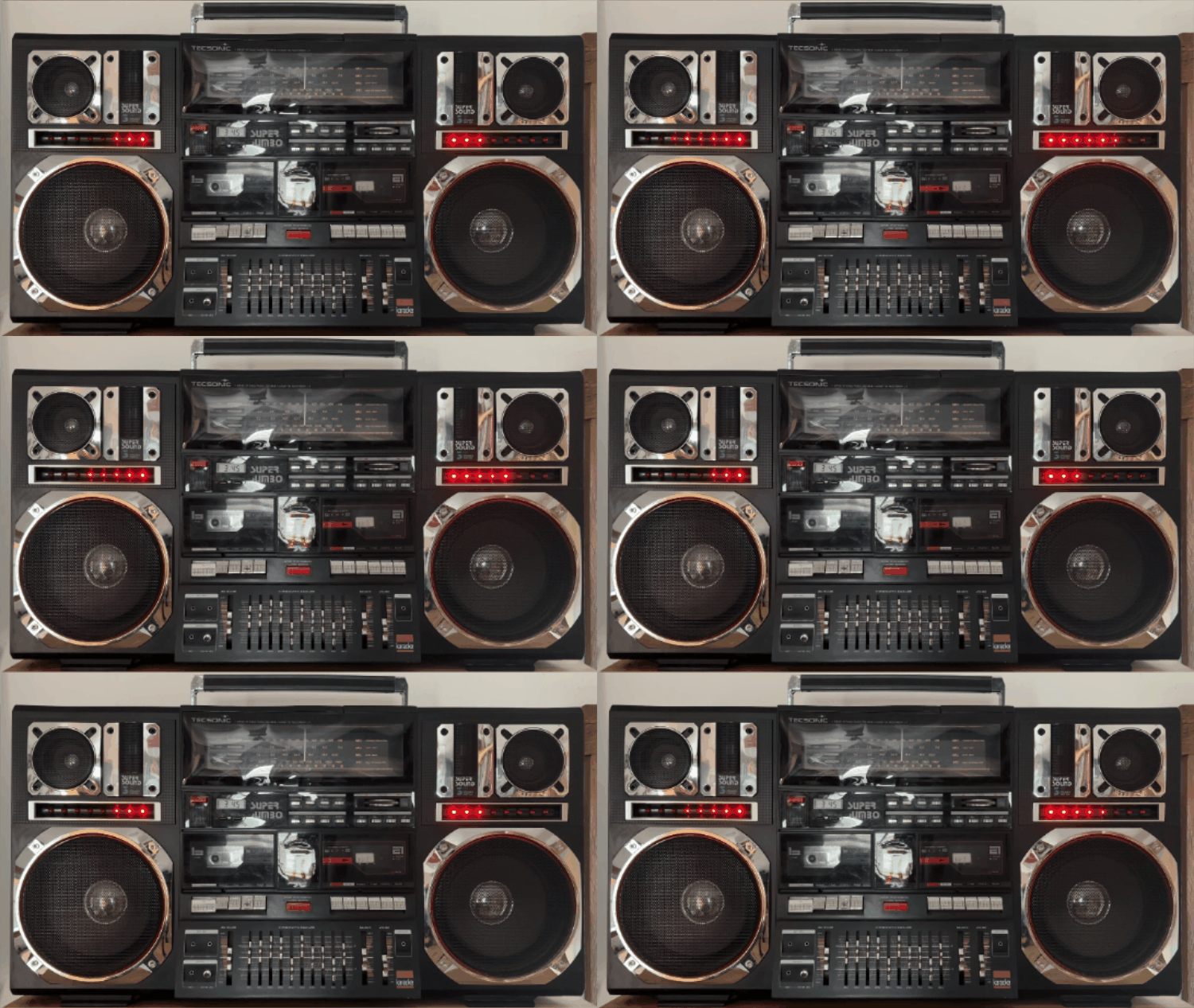 |
As I clicked the “Buy It Now” button to spend $1500 on a semi-functional boom box, I heard my dad’s voice, saying two different things during my childhood: “A fool and his money are soon parted,” and “This is The Beatles.”
I had literally just told Hilary in the kitchen maybe two minutes before that I was NOT going to buy this boom box that was 16.5 inches tall, 31 inches wide, was manufactured in 1988, and if not plugged into an electrical outlet, needed 20 D batteries to operate. And then I walked out the door with our dog, got 25 steps into our morning walk, and said “fuck it” as I tapped “Buy It Now” on the listing: 80s Ultra Rare Tecsonic J-1 Super Jumbo Boombox GhettoBlaster Nearly 3 Feet LONG
The next morning, a warm Friday in August 2021, I drove to Spokane to pick it up from a guy named Steve, who had messaged me to suggest that it might be safer for me to personally drive it back to my house instead of shipping it, and I agreed.
When I met him in front of his house, he thanked me for buying the boombox from him, as things had been a little tight for his family after the pandemic. And, he said, “I did a little research on this thing—it’s apparently like the holy grail of boom boxes.”
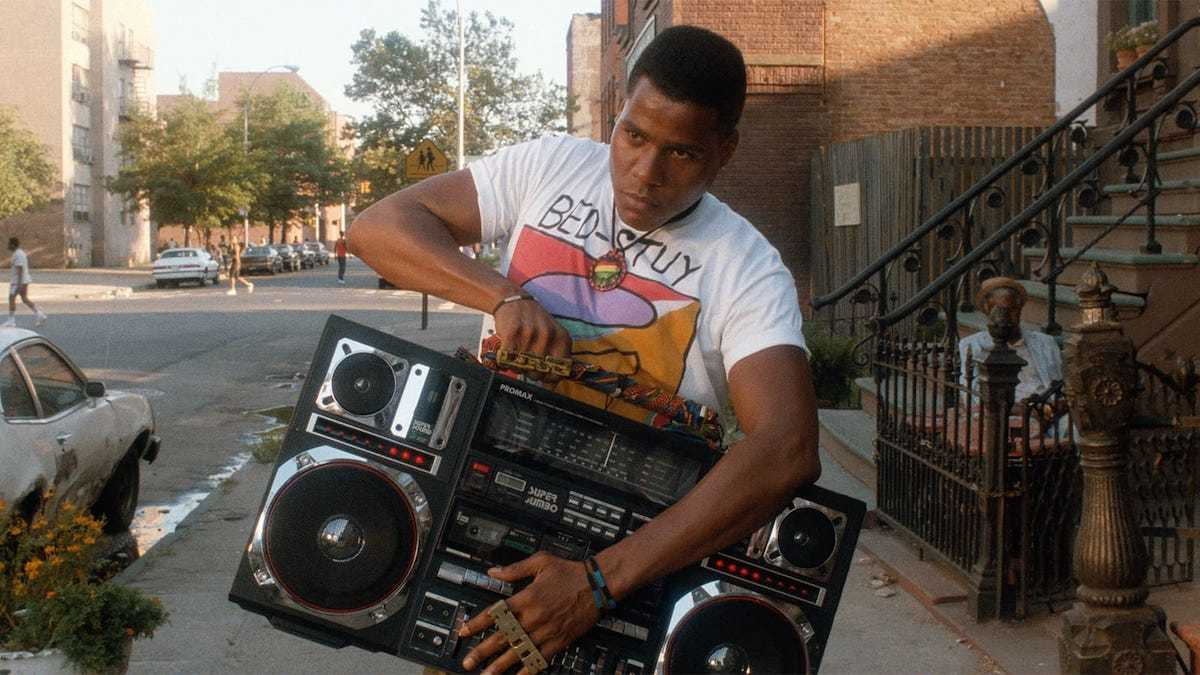
I said I know, the only other one I’ve seen in person was behind the glass in the Smithsonian National Museum of African American History and Culture. It’s the one they used for the film Do The Right Thing, or, actually, one of two used in the film as Radio Raheem’s big boom box (one was a Tecsonic, the other was the almost-identical Promax model).
 |
I was 42 years old, well aware of the ridiculousness of spending that much money on a piece of musical equipment that allegedly worked. One type of person might say “it’s just a boombox,” but another type of person, which I have been for a long time, would know that it was not just a boombox. Because is it ever just music?
--
My first musical memory was also my first experience with music piracy: Mike, a guy who worked for my dad in the meat department he managed at Fareway in Red Oak, Iowa, had recorded a handful of Beatles records onto cassette tapes for my dad, hand-writing the song titles on the case liners. Songs like "Eleanor Rigby," "Come Together," "Revolution," "Ob-La-Di, Ob-La-Da," "Ticket to Ride," "Can’t Buy Me Love," and the rest of the tracks on those albums still call up images of the little rental house we lived in when I was five years old.
At our next house, I must have been allowed to play with my dad’s stereo equipment, because I have distinct memories of making my dad’s Beach Boys’ record do laps of “Good Vibrations,” the chorus of which I had heard in a commercial for Sunkist Orange Soda. I can still hear the click of the STOP and REWIND buttons on the cassette player I used to play “Spaceman” on Harry Nilsson’s Greatest Hits album.
During elementary and middle school, whatever was playing on pop radio was what we listened to, when our clock radios woke us up, in the car, and over the loudspeakers at the city swimming pool. My mom thought we were a little young to watch MTV, so we only saw it when we had a babysitter come over.
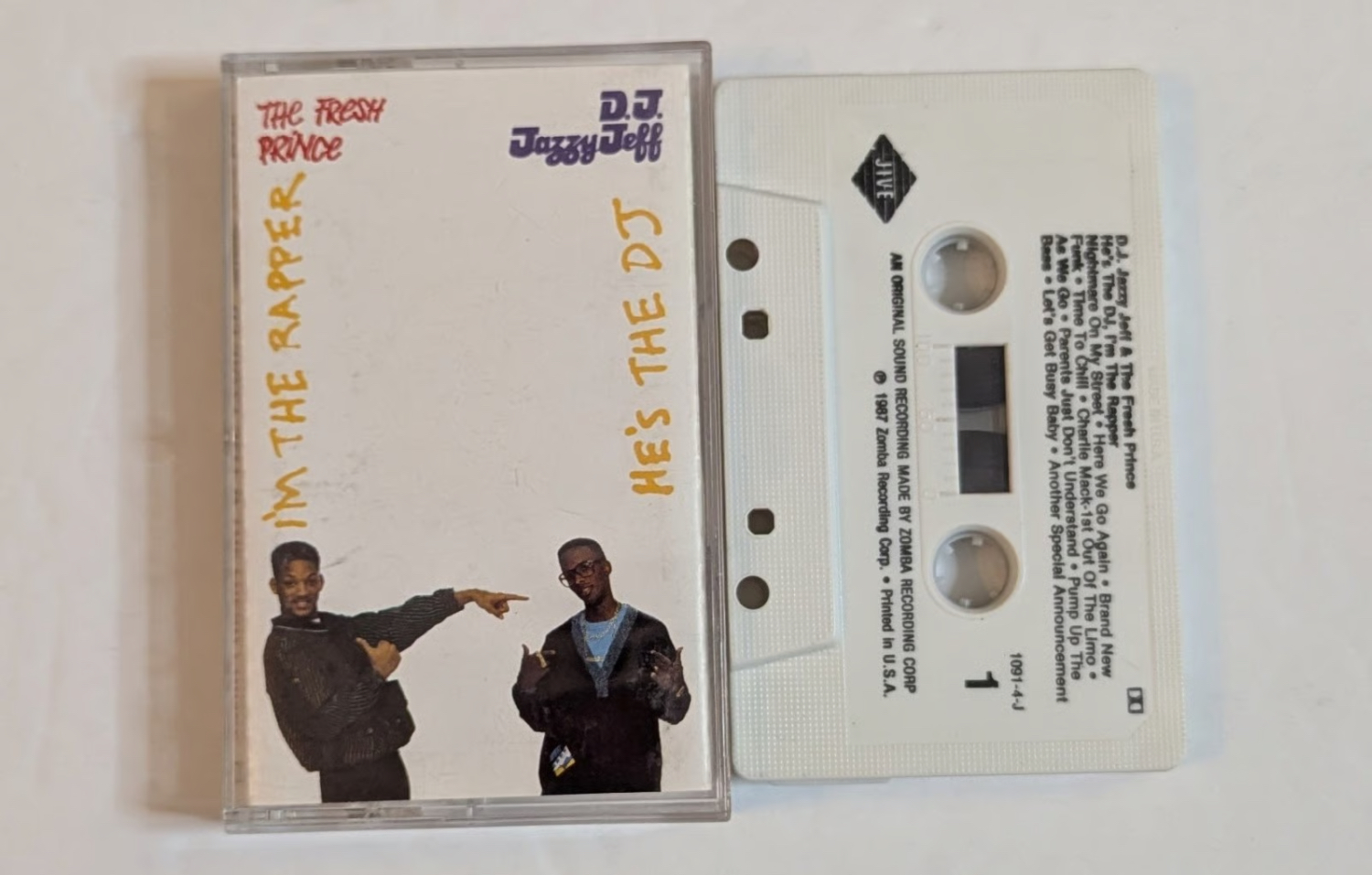
Then, in the summer of 1988, rap music made it to the radio stations we picked up from Omaha, Nebraska, when DJ Jazzy Jeff and the Fresh Prince’s single “Parents Just Don’t Understand” crossed over. My brother and his friends liked it enough that Chad bought He’s the DJ, I’m the Rapper, a double album that fit on one cassette. This must have been the beginning for me—a song that probably sounded pretty corny to people over the age of 25, but that resonated with teenagers and soon-to-be-teenagers.
 |
A few more rap songs crossed over to pop radio in the next year—Young MC’s “Bust a Move” and Tone Loc’s “Wild Thing,” and it became the era of way too many companies trying to incorporate “rap” in their TV commercials, making the cringiest of cringe jingles, maybe the worst of which will never leave my brain: the animated Barney Rubble from the Flintstones, wearing a gold chain and rapping “I’m the master rapper and I’m here to say/I love Fruit Pebbles in a major way.”
In 1990, my brother started junior high, and brought home copies of ROJH Today, the student newspaper, which I picked up and read voraciously for details of what junior high might be like. Chris Phillips, who was a year ahead of Chad and a columnist for the newspaper, wrote a piece about preparing for one of his eighth-grade basketball games, mentioning very specifically listening to the Public Enemy track “Welcome to the Terrordome.”
There was no way of listening to Public Enemy, of course, unless you owned their albums. Which I didn’t. But this was also the era of the “Get 10 CDs for a penny” deals from Columbia House and BMG, where you’d get a big box of CDs in the mail, agreeing to buy two albums (I think?) over the next year to fulfill a membership agreement. Chad was sitting with his most recent Columbia House catalog one day, asking me what he should order next, and I told him to get Public Enemy’s Fear of a Black Planet album, and Ice T’s O.G. Original Gangster.
When the CDs arrived, Chad listened to them a few times, decided he wasn’t that into them, and I inherited both. Ice T’s album was an adventure, lyrically, full of profanity, sexual content, stories about gangs and drug dealing and prison—the kind of stuff you probably felt like you should admit you listened to when you went to your next confession with a Catholic priest (as I probably did?).
But Public Enemy was a revelation, musically. It was loud, it was noisy, and Chuck D’s booming voice commanded you listen to the words he was saying. Decades later, a music journalist wrote something to the effect of “Public Enemy FELT important,” and that exactly captured what it was like for me.
Through the rest of middle school, I used lawnmowing money to buy hip hop compilation tapes at KMart, and eventually CDs of the artists I saw on Yo! MTV Raps: Rakim, Black Sheep, Pete Rock & CL Smooth, The Beastie Boys, Ice Cube, Naughty By Nature, X-Clan, A Tribe Called Quest, Gang Starr, The Pharcyde.
 |
Maybe you’ve had this experience of “discovering” something that resonated so deeply that it feels like it was out there the whole time just waiting for you to find it. My brother was more into Jimi Hendrix and Van Halen, my dad didn’t like any rap music, and my mom sort of tolerated it but would probably have preferred silence. Hip hop was mine. Hardly anyone at school seemed to get it like I thought I did—besides my friend Justin, whose mom must not have heard any of the lyrics of the Ice T songs we listened to while we played basketball in his driveway.
Justin and I were just a couple kids in a town of 6,000 people who found this music—white kids, who had almost zero in-person exposure to the language, situations, and places that comprised hip hop. At the time, though, thousands of other small-town and suburban kids were discovering hip hop through Yo! MTV Raps on weekdays and Saturday mornings from 1988 to 1995. The people making it didn’t look like us, but it spoke to us—or maybe that’s WHY it spoke to us.
The Public Enemy albums I owned—Fear of a Black Planet, Apocalypse 91: The Enemy Strikes Black, and It Takes a Nation of Millions to Hold Us Back—all came with liner notes in the CD cases, and in the liner notes were Chuck D’s lyrics. And in those lyrics were references to things I’d never heard of in history class: Malcolm X, Marcus Garvey, Angela Davis, Emmett Till, Huey Newton. In 1990, the Parental Advisory label was introduced and appeared on the covers of almost all my favorite hip hop CDs (I blacked it out with a Sharpie, which I thought was clever). Sure, the Public Enemy records were explicit at times, in the definition of explicit that includes profanity. But more importantly for me, they were explicit in explaining Black American history, dense with references.
I listened to the songs on repeat, read the liner notes, tried to look up the proper nouns in the liner notes in the encyclopedias we had at home, or at the library if I couldn’t find it in our home encyclopedias. I read The Autobiography of Malcolm X when I was 13, but I can’t recall ever reading his name in a history book in my junior high or high school classes.
--
In high school, we had moved to a new town, and I had close friends in high school, but no one who LOVED hip hop. This was the height of grunge, and I spent many weekend and weeknight evenings discussing the meanings of cryptic Pearl Jam and Nirvana lyrics with my friends in the dish pit at the Pinicon Restaurant or in the seats of crappy cars driving nowhere on gravel roads as we chugged cheap beer. I still listened to hip hop, picked up issues of The Source when my friends and I made the one-hour drive to Waterloo to patronize the nearest record stores (the closest place you could purchase a CD). I mostly kept my favorite albums—Tribe’s Midnight Marauders, Enter the Wu-Tang 36 Chambers, Illmatic, Ill Communication, in my own headphones, or playing on a small boombox in my bedroom. Nobody else got it, I felt at the time, not realizing that I didn’t really get it either.
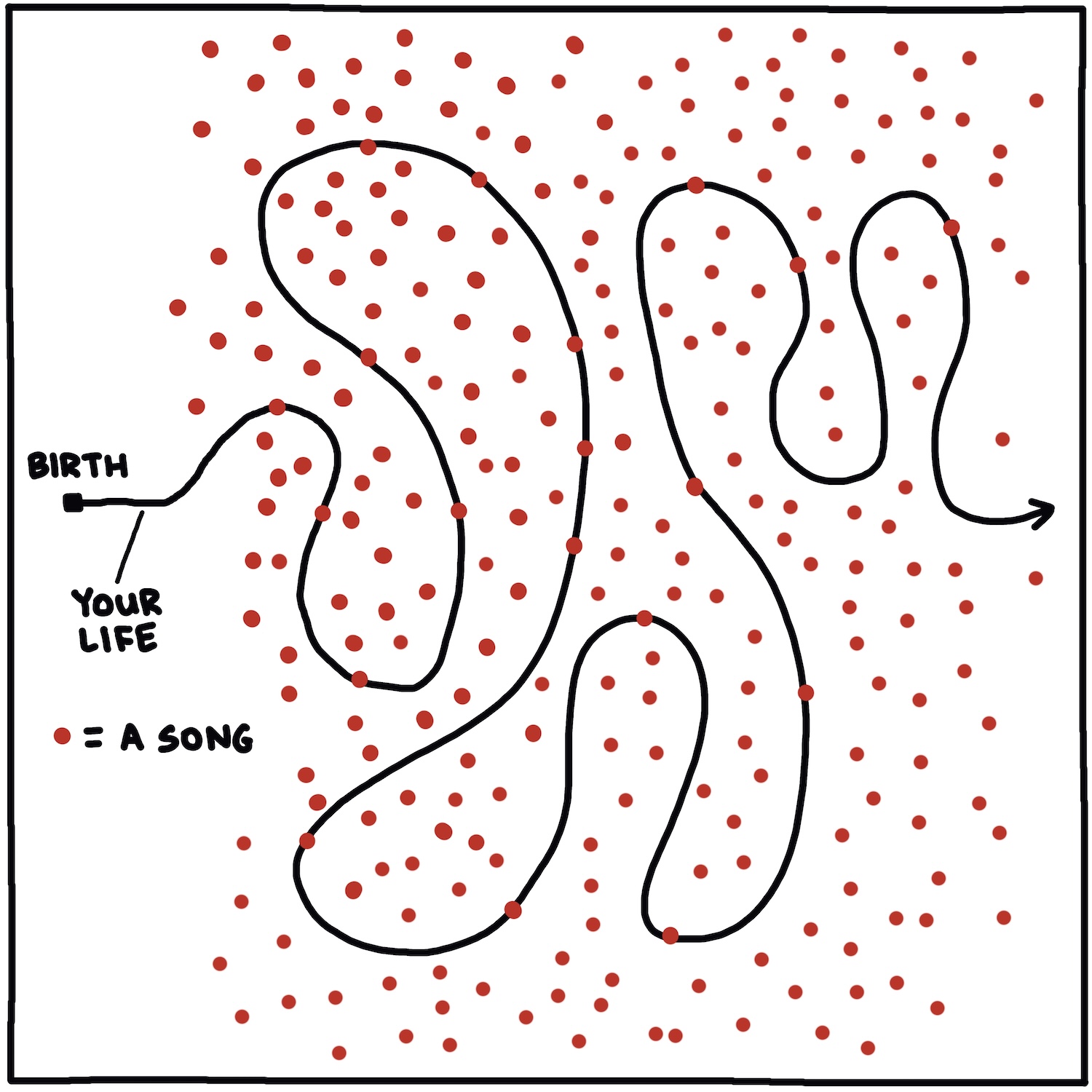
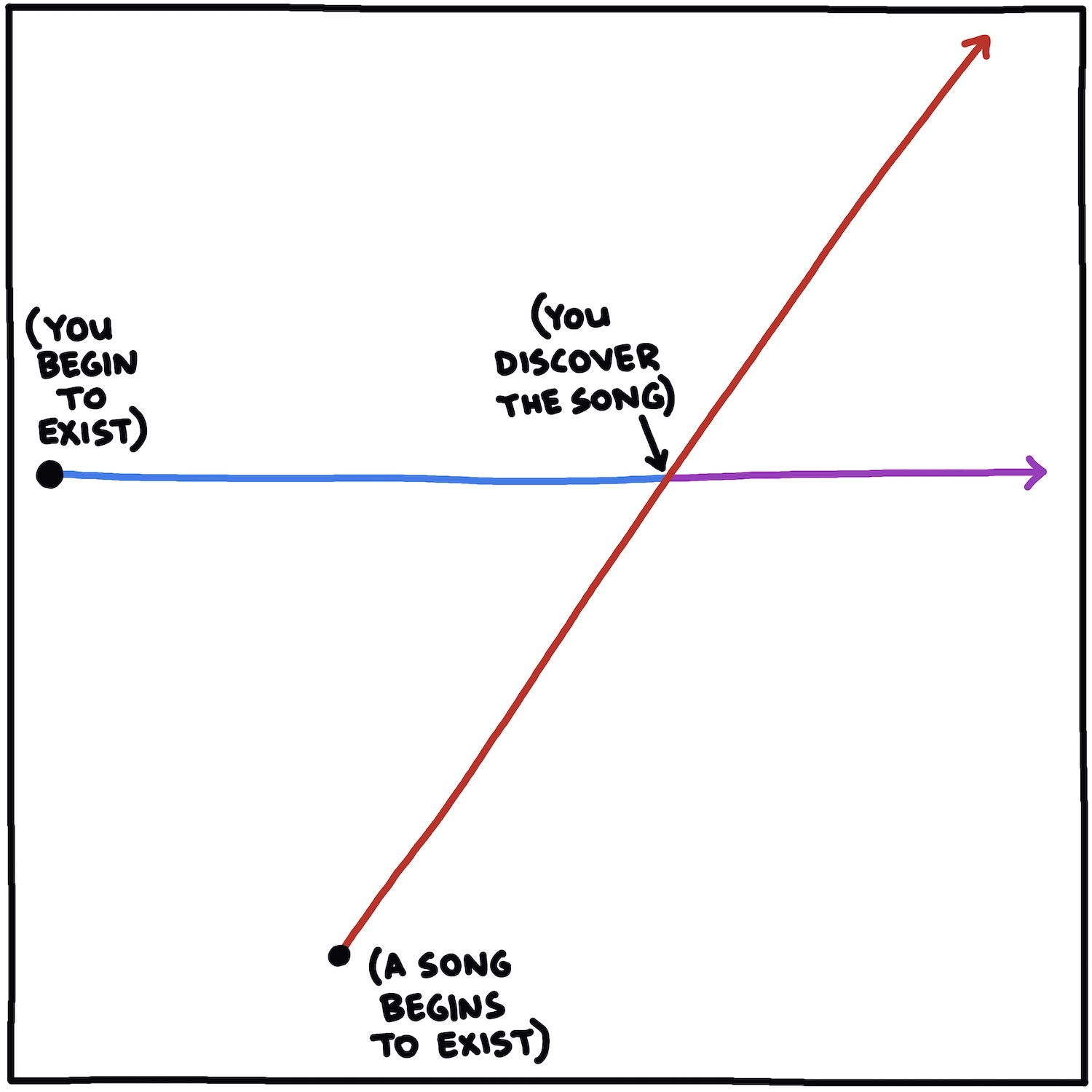
Is this how music works? We find it, or it finds us, and connect when the right song or lyric hits at the right time and feels like The Truth, because the song is about falling in love and we just happen to be falling in love at the time, or it’s a breakup song and we’re going through a breakup, or it’s celebrating a thing that we feel like celebrating too, or it’s explaining something we’re curious about, a different world that we know is out there somewhere, just not where we live?
 |
--
In the summer of 1993, Dr. Dre's song "Nuthin' but a 'G' Thang" went mainstream, and I knew this because everyone in my small town of 3,000 people in the northeast corner of Iowa, in the dead-center of the flyover country Midwest, seemed to be listening to it. It was on MTV, not Yo! MTV Raps, but regular MTV. People I knew bought The Chronic, sometimes the first rap album they’d ever owned. Did anyone know what the G stood for? Did it matter? People had been misunderstanding Bruce Springsteen’s “Born in the U.S.A.” for almost a decade at that point. They were accepting rap and hip-hop, in a way. I liked The Chronic, but didn’t even buy the album—I’d been blacking out “explicit lyrics” labels on my CDs for a couple years, but thought The Chronic’s four-and-a-half-inch marijuana leaf covering the disc when you pulled it out of the jewel case might be a bit harder to conceal. Plus maybe a not-so-small part of me wanted to listen to stuff that not everyone was listening to.
And my stuff was coming that winter: On November 9, Midnight Marauders dropped, on the same day as Enter the Wu-Tang (36 Chambers). I bought Midnight Marauders shortly after it came out, and was once again entranced by Tribe’s fusion of jazz and lyrics. Was it better than their previous album, The Low End Theory? I listened to “Award Tour” on repeat in my headphones as my dad drove me to early-morning freshman basketball practice, sure that it was my favorite Tribe album.
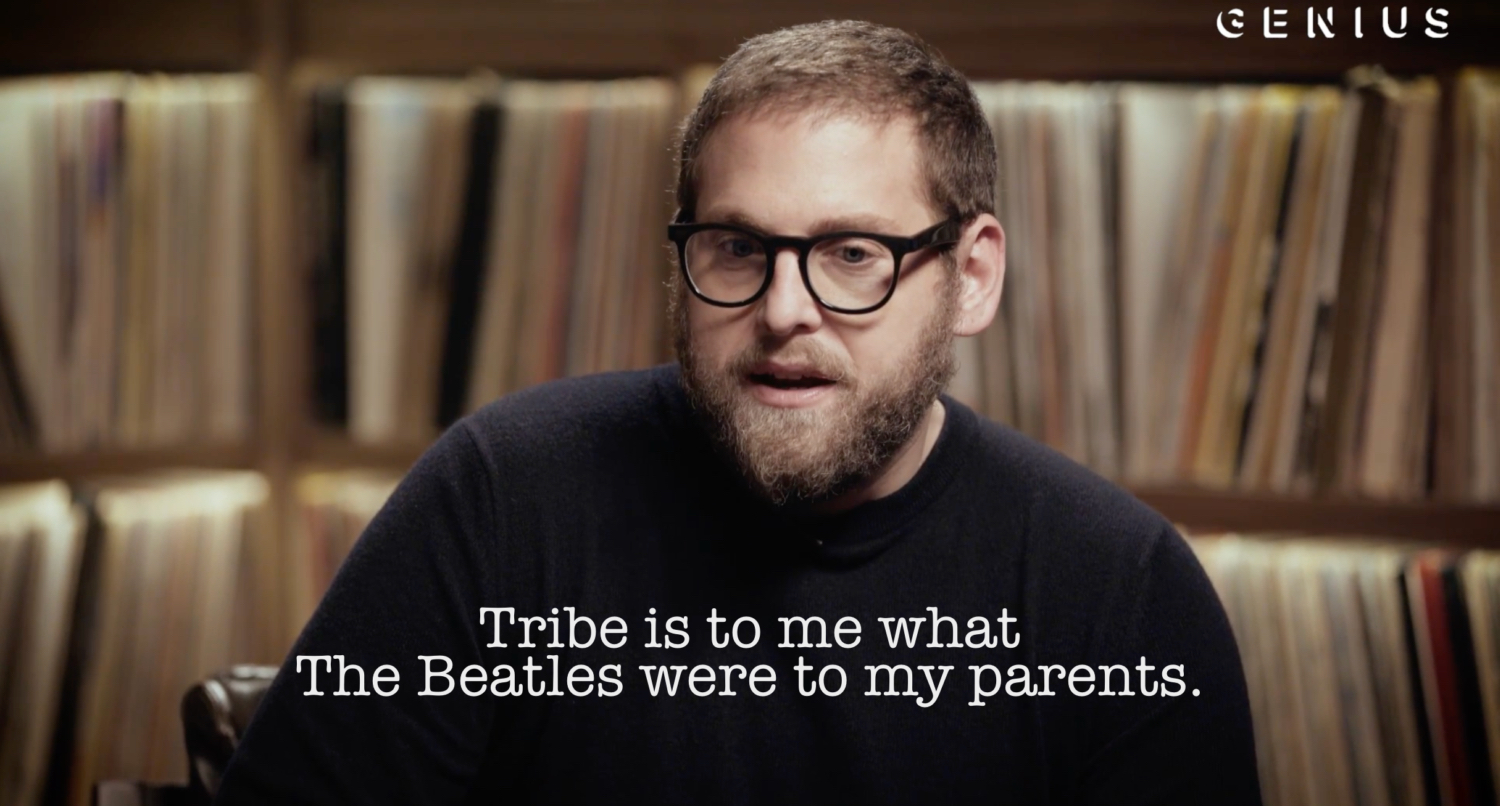
Years later, I was listening to Jonah Hill do an interview about his 2018 movie mid90s, specifically about the film’s hip-hop heavy soundtrack, and he said this:
 |
I borrowed the Wu-Tang 36 Chambers CD from Travis, a friend’s older brother, and recorded it onto a blank cassette, transcribing the song names in pen on the cassette liner. I had read an article about the Wu-Tang Clan in The Source that winter before I’d ever heard their music, and was so curious about it: Nine members from Staten Island, talking about old martial arts movies, but also hip-hop? How could that work at all, let alone sound good? It did.
Somehow, without understanding a great many of the expressions and slang in rap lyrics, I learned enough of the language to have an idea of what was going on in the songs. What I missed at the time—or heard, but was too naive to understand—was that the bravado, the imagery, and large parts of some of the personas of the rappers I listened to came from trauma. I could not have been physically farther from the challenges of the 1990s urban Black experience as I sat in my comfortable bedroom in a house a mile from a small town in Iowa. I just thought the music sounded cool.
I didn’t mind growing up where I grew up, which felt as rural as you could get. The nearest movie theater was 20 miles away, and the nearest escalator was 45 miles away. It was the kind of environment celebrated in country songs—but for whatever reason, country music didn’t really grab a hold of me. The stuff I wanted to listened to—rap music—was set for the most part in the biggest cities in the country, where more people lived in one square mile than in my entire 500-square mile county.
I picked up Nas’s Illmatic sometime in the spring of 1994, after reading the hype about it in an issue of The Source (which gave it the almost unheard-of Five Mics rating), and listened as he painted scenes a world away:
Now it's all about cash in abundance
N***as I used to run with is rich or doin’ years in the hundreds
I switched my motto; instead of sayin’ fuck tomorrow
that buck that bought a bottle could've struck the lotto
Once I stood on the block, loose cracks produce stacks
I cooked up and cut small pieces to get my loot back
If country music told stories about places familiar to me, rap enabled an escape from those places. The best lyrics took me to places I’d probably never see. Years after this, a friend would joke about how white people couldn’t possibly relate to rap lyrics, and I didn’t respond, but some time later realized that that was never the point. Most of us can’t relate to Anne Frank’s diaries, or Harry Potter, for that matter.
--
My freshman year of college, Puff Daddy was everywhere on MTV. No one predicted the monster he’d become (or maybe he already was a monster but few people knew it yet), but something just didn’t feel authentic about his music, compared to the hip hop I’d fallen in love with a few years before. The producers I loved—Pete Rock, Q-Tip, and DJ Premier—would ingeniously craft small samples of obscure jazz, soul, and funk songs into hip hop beats. Puffy, on the other hand, would take the beats or choruses of huge pop songs and barely flip them into background tracks for poppy songs that seemed to go straight to Total Request Live. Making “I’ll Be Missing You” as a tribute after Biggie was shot and died somehow felt opportunistic. Plus: Puffy became really, really successful—mainstream successful, which seemed undeserved, to me.
Whatever it was, it seemed like rap was crossing over into the mainstream, but it wasn’t the rap I wanted to engage with. So I stopped paying attention.
--
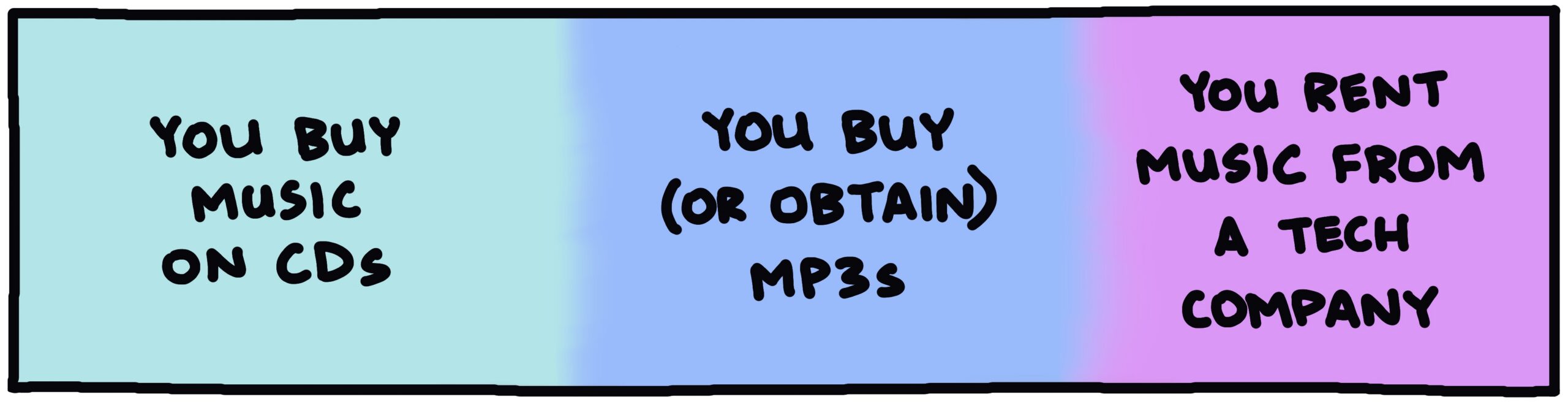 |
I continued to collect music through grad school and my mid-20s, sometimes through Napster or other filesharing sites, and sometimes through checking out CDs from the Denver Public Library, whose main branch was a block away from my office and had an inexplicably well-curated rap selection. Between the albums I’d bought and the CD-Rs I’d copied albums onto, I had about 700 albums.
I got an iPod in 2005 or 2006, and then the biggest iPod a year or two later. My whole library was now available on iTunes, which I played on speakers connected to a desktop PC whose storage capacity eventually became dominated by my music collection.
In 2009, I realized I hadn’t put a CD into a CD playing apparatus in a long time. I’d taken a pay cut from a newspaper job to work at a nonprofit, and I needed more cash than I was making. So I semi-reluctantly put an ad on Craigslist for someone to buy all of my CDs, which were then housed in huge black wallets that held 200 discs.
To my dismay, a guy responded to the ad, and we arranged to meet at my office. I sat there on the front porch watching him flip through all the discs, in mild disbelief that I was going to let this collection go for a couple hundred dollars. This was my personal history, since about age 13. Fear of a Black Planet was in there, as well as my other Public Enemy albums. All my Tribe Called Quest.
But, I had told myself: I still had all the music, digitally. I could listen to it at any time. Couldn’t I? Fuck.
The guy was nice. And he seemed excited—wow, you have all the Led Zeppelin studio albums, great, OK, some Grateful Dead, yeah. I love hip hop too. Bob Marley, Songs of Freedom box set, great. He looked up at me for a second, then said:
You know man, I’m divorced, and I have full custody of my kids. I get one day off every couple weeks, and I got this room in my house where I have this huge stereo. My day off from my kids, I go in there and I just. Listen. To. Music. All. Day.
My blood pressure dropped, I let out a breath, my shoulders relaxed. We shook hands, he gave me a wad of bills, and carried the wallets full of my music to his car. It was going to be OK, and I could pay my rent.
--
When I run in my neighborhood, I see this bumper sticker on a car that says, “I MAY BE OLD BUT I GOT TO SEE ALL THE COOL BANDS.”
At first I thought, “I wonder what bands they’re referring to?” And then I realized that probably everyone thinks that the cool bands/important musicians are the ones they listened to when they were young. And maybe that to grow “old” is to watch everything change, and realize that “cool” is subjective and partly dependent on when you were “young.” At some point, that bumper sticker is relevant to all of us, if we live long enough.
Around 2012 or 2013, I relented to what seemed inevitable and started streaming all my music through Spotify, later switching to Apple Music. My music collection was over 1,000 albums at that point, but it all fit on a hard drive. iTunes had some glitches and sometimes wouldn’t recognize that I owned a song that I’d uploaded from a CD in whatever year, so I finally just gave up and figured I could listen to anything I wanted via an internet connection. But I kept the hard drive around, periodically copying the files over to a new hard drive, just in case. I remained somewhat aware of rap music, finding a few artists that I liked, occasionally dipping back into artists from my teens to listen to some old stuff, which still held magic for me.
In 2015, the trailer for the documentary Stretch and Bobbito: Radio That Changed Lives popped up in my feed, and in two minutes of watching it, fires of nostalgia came alive in my brain. I rented the documentary and watched it, twice, re-living some of the glory days of underground hip hop with the now-famous people who were, back then, excited and grateful to have a chance to freestyle on this very-late-night show on a dinky little New York radio station: Jay Z, Busta Rhymes, Nas, Common, Eminem.
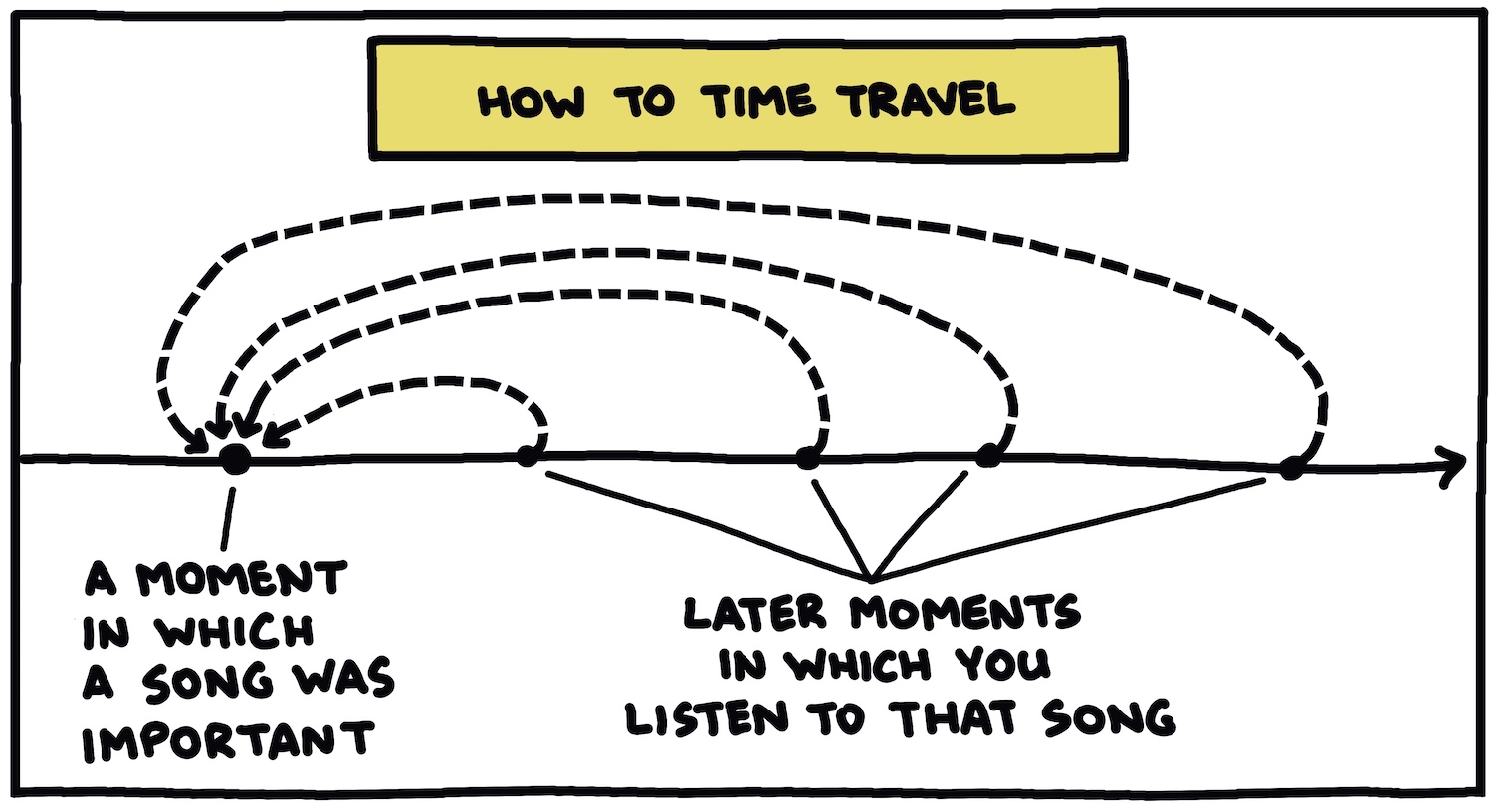
I bought a small Sanyo boombox with a cassette player that fit on the counter of our little Denver condo, and every once in a while, I’d pop in a tape of some old hip hop. The music was one thing, but with the click of the PLAY button, and the less-than-perfect sound that came out of the speakers, it felt like time traveling.
--
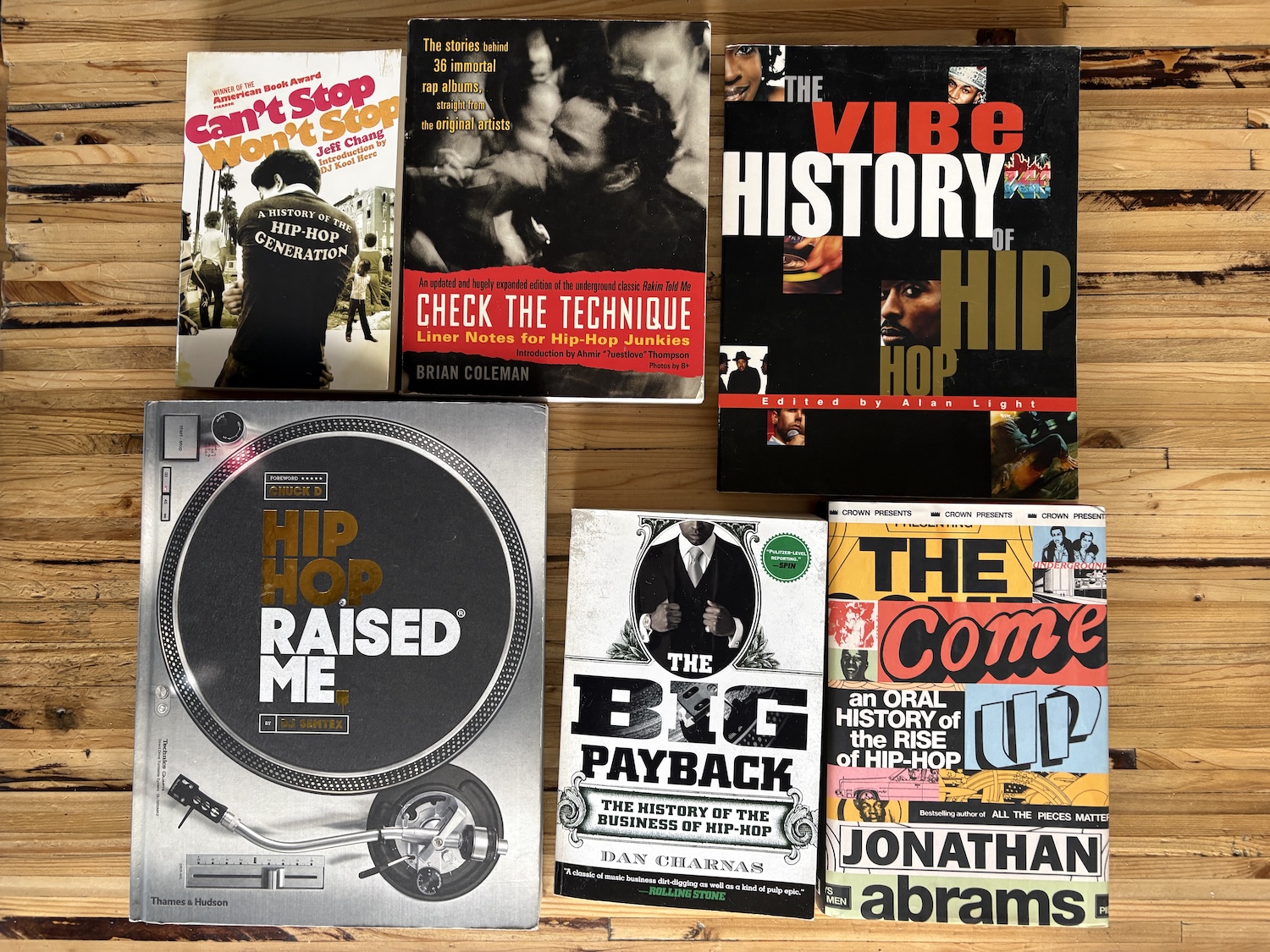 |
My love for the music was validated starting in the mid-2000s, as hip hop history books started coming out: Can’t Stop Won’t Stop by Jeff Chang, The Big Payback by Dan Charnas, The Vibe History of Hip Hop, Hip Hop Raised Me by DJ Semtex, Check The Technique: Liner Notes For Hip-Hop Junkies by Brian Coleman, The Come Up by Jonathan Abrams.
I read as many as I could, in love with the mythology, re-living events I had not been present for, the names I already knew were responsible for the late ’70s/early ’80s seeds that became the Boom Bap that hooked me: Kool Herc, Grandmaster Flash, The Cold Crush Brothers, Grandmaster Caz, Afrika Bambaataa, Grand Wizzard Theodore. Eventually, I started to feel like I was just reading slightly different angles of the same historic events, and maybe I knew enough about hip hop that I could stop buying every book that chronicled the early days.
--
 |
In “The Power of Nostalgic Music,” YouTuber Nathan Zed says:
“I’d argue—hot take here—that music is only as good as the memories that are attached to it.” Which would explain why the songs I associate with road trips in my 20s and early 30s feel so much more powerful than songs I associate with working on spreadsheets in my 40s.
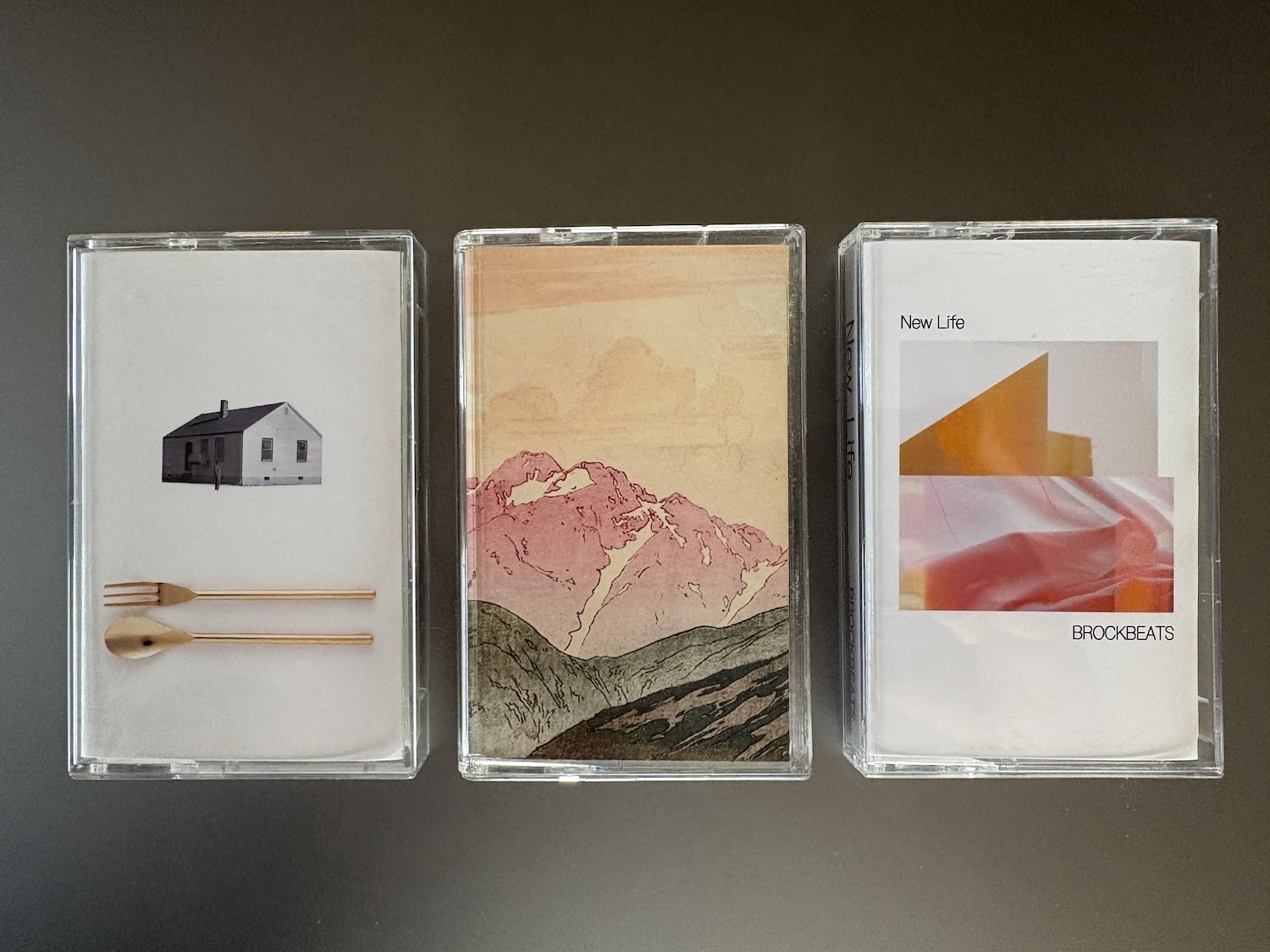
Five or six years ago, I realized I was almost defaulting to listening to chillhop whenever I turned on music. It was lofi, no lyrics, hip hop beats that sounded like they might be coming out of old boombox speakers. It was easy to listen to, or, more importantly, it wasn’t distracting. I could listen to it while writing, or drawing, or doing anything I needed to concentrate on.
 |
I was listening to music, and I wasn't unhappy, but it didn’t feel like it was affecting me at all. I chalked it up to entering middle age, and would trot out a reference to the many studies that have shown that most of us stop discovering new music in our 30s.
So then, what are we doing? Listening to only the music we listened to when we were young?
When I turn on a hip hop song from the 90s, the visuals that pop into my head are almost always the same: My carpeted bedroom on the second floor of the house, me sitting on a plaid duvet on my bed, maybe flipping through the pages of an issue of The Source. If the blinds are open, the scene out the window is a grassy lawn, cars going by on the highway 120 feet away, a few houses behind ours and a few on the opposite side of the highway, but beyond that, corn for miles. I can almost—but not quite—hear the CD player click as I close the lid on my boom box, a later model with rounded edges, maybe 18 inches wide, and then the laser making a couple subtle noises as it begins to scan the disc. Maybe a couple clicks of the button to advance the album to the track I want to listen to first— “Life’s a Bitch” (track 3 on Illmatic), or “Award Tour” on Midnight Marauders (also track 3), “Jazz (We’ve Got)” (track 11 on The Low End Theory, “C.R.E.A.M.” (track 8 on 36 Chambers).
I don’t have an emotion attached to those songs beyond a feeling of nostalgia for the experience: Discovering music that was mine, on my own, and not sharing it with anyone.
--
After Jay was born, I was on the phone with my friend Ian, a professional musician who was about to become a parent, and he asked: Are you going to listen to rap with Jay? You worried about him picking up curse words?
I told Ian I thought I would at some point, and that I wasn’t so worried about Jay hearing the F-word in a song and repeating it at school—I was more concerned with him hearing the N-word in song lyrics. And, you know, other stuff: lyrics that are violent or misogynistic. Which he’ll hear someday, if not in a hip hop song, in other music. Or in a movie, or he’ll read it in a book.
I guess I would amend my answer to: Sure, when he’s older, and we can have a conversation about nuance and art. But for now, in an ironic twist, we can listen to clean versions of some stuff.
--
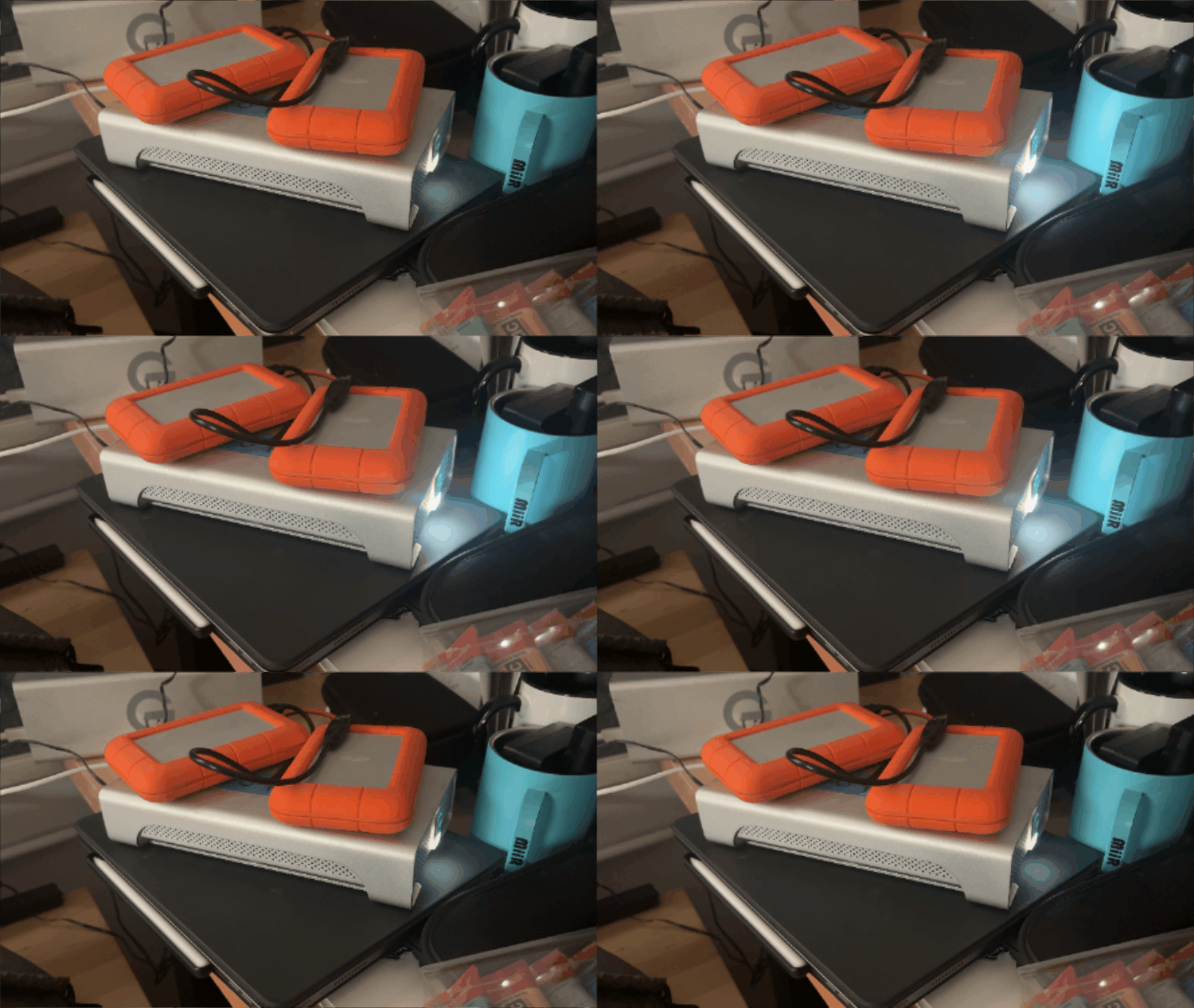
Last December, I had a moment of panic. I was digging through a box of old hard drives looking for a video file when I froze for a second, for absolutely no reason suddenly remembering that all the music I’d collected through legal and not-as-legal means from 1990ish through about 2013 was sitting on one hard drive, and I didn’t know which one it was.
I hadn’t accessed said music on said hard drive in several years, I tried to remind myself. But what if it was gone? Hard drives don’t last forever. I frantically started fishing out cables and plugging them into my laptop, one by one, looking for the file, which must have been huge, right? Well over 1,000 albums. Whew, there it is. Better copy that to another drive.
 |
--
Standing in Steve’s front yard in Spokane, I looked at the boombox, soon to be riding east on I-90 with me back to Missoula.
“Where did you find this one?” I asked Steve.
At a garage sale in the neighborhood, he said.
Oh wow, I said. How much was it?
You don’t want to know, he said, and we both laughed.
I said that’s OK. Then we got talking about art, and he told me a little bit about his paintings, and I must have seemed excited, because next thing I know I’m standing in the basement looking at some of his paintings, and we’re talking all about art.
As we walked out to the front yard again, Steve, unprompted, said: I found that boombox at a yard sale a few blocks away, and I plugged it in to see if it worked, and it seemed OK. I asked the lady how much she wanted for it. She said it was her son’s, and he was out putting up signs. She said he wanted 50 bucks for it. But you can have it for 40 dollars.
I just laughed. Good for you, Steve. That’s how it works. I thanked him and strapped the boombox in the backseat for the three-hour drive home.
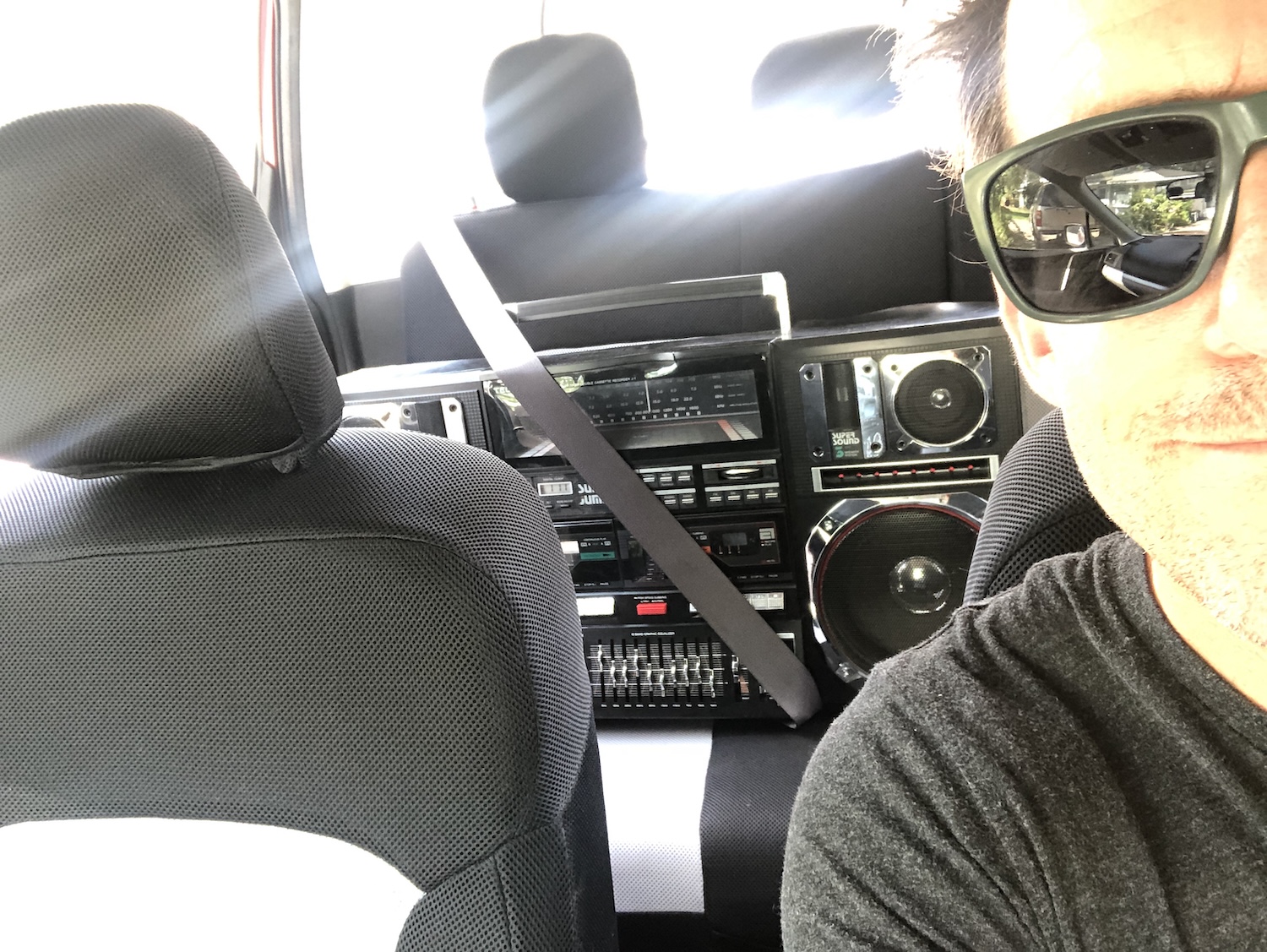 |
Back in my kitchen, I plugged in the holy grail, my boom box, the Tecsonic J-1 Super Jumbo. It worked OK, aside from one of the speakers going out whenever I moved the volume slider. I’d look into getting that fixed, I thought, well aware that the pool of people qualified to work on antique stereo equipment was probably not very deep in western Montana.
On a utilitarian level, it was a lot of money to spend on a giant piece of equipment that was past its prime, something that was an antiquated way of playing old music, on a medium not known for producing quality sound. So why did I need it?
I don’t know. Steve said “holy grail,” which is what you might call it if you were a collector. But I think it was something else. Like buying that big-ass boom box was the most audacious expression I could manage for the love I have for the music—and maybe not even the music, but the love for the few years I got to spend falling in love with the music, when it felt like the most important but most private thing I had. For all the time I had to do nothing but listen to music by myself in my little room, and wonder about a world far from the one I knew.
--
If you enjoyed this piece, please consider supporting my work.
Semi-Rad
Writer, artist, filmmaker, columnist for Outside Magazine. My newsletter about creativity, adventure, and enthusiasm goes out to 15,000+ subscribers every week.
Friday Inspiration 535 Martin sent this to me last weekend with the subject line "Indonesian, Muslim, female, Hijab wearing, metal band" and I was pretty sure I was going to like it. I was correct. Wait for the bass solo at about 4:40. (video) You’ve probably heard some version of the oft-quoted saying, “The best time to plant a tree was 20 years ago. The second-best time is now." Well, if you want to up your game a little bit, maybe the second-best time to plant a Miyawaki forest (or a...

A Five-Year Project Nearing Near-Completion In October 2021, we found out we were going to have a baby. Naturally, I was terrified. I did what many terrified parents-to-be do, and I started reading parenting books, almost all of which were quite helpful. But I kind of wanted something besides books written by experts, or journalists who had interviewed a bunch of experts. So over the course of the next few months, I decided I would interview some people who already had the job I was going to...
Friday Inspiration 534 This is just a really pleasant way to spend 3 minutes: Watching backcountry ice skaters in Alaska, brought to you by adventure legend Luc Mehl. (video) (thanks, Alice) Hilary has been taking classes to get her Montana Master Naturalist certification, so I have been getting to hear a lot about plants and birds over the past several months. (Like, more than I normally do.) AND, I got to read this amazing little piece about this insane thing that the earth does at...